thing

Creature Feature

In these articles I will look at specific monsters or monster categories and discuss their history in the world as well as their history in film.

ZOMBIES!

Posted 3/14/2026

Unlike many of our movie monsters, zombie’s origins come from reality…sort of.  However, the zombies of today’s horror movies are far-removed from the actual zombies of history as well as the original zombies of film.

 In Haiti, stories were told of people who buried their loved ones only to encounter them months later, working in a mindless state or wandering the roads.  Zombies came into the new world’s awareness in about 1929 when the book The Magic Island by William Seabrook was released.  In it he made mention of the zombie.  In Haiti it seemed, “dead” people rose to become zombies and work the fields and do other mindless labor.  Later, this phenomenon was explored in depth by Wade Davis, in 1985 and recounted in his book The Serpent and the Rainbow.  This tale of his discovery of and search for the explanation of zombies was fictionalized in the 1988 film of the same name by Wes Craven. The process of creating zombies is practiced in the religion of voodoo and done exclusively by the shaman or priest known as a boker.  In actuality, the priest poisons a human being with a drug concoction passed along among voodoo priests.  This drug slows the breathing and heart rate enough to make the victim appear dead.  Mistaken as deceased, he is buried.  Within 6 days the boker digs up this body and revives it with another concoction.  He further deadens the mind and destroys the will of his victim with more drugs making them susceptible to control from a “master.”  Their lifeless and mindless countenance coupled with the fact that they were pronounced dead and were buried created the myth of the reanimated corpse. 

The first movie using zombies was inspired by The Magic Island and took the use of zombies to reflect the effects of colonialism on other populations.  The movie was White Zombie (1932) and in it a rich plantation owner played by Bela Lugosi used native zombies to run his plantation.  Things go wrong when he attempt to turn a white bride-to-be into one of his minions after he falls for her.  A few scattered movies followed using the same zombie template of Haitian, mindless, controlled workers made from raising the dead.  Overall, though, zombies were not commonly used monsters in the horror movies prior to 1968.  Rare examples include Revolt of the Zombies (1936), Voodoo Man (1944), and the superior I walked with a Zombie (1943) by Val Lewton.

But in 1968 George Romero released Night of the Living Dead and zombies in cinema would be forever changed.  No longer would they be the mindless, docile work force of Haitian history or created by voodoo priests.

It is important to note that the creatures in that movie were not intended to be and never referred to as zombies in the film.  In fact, they are referred to as what they really were, ghouls.  While zombies were essentially harmless slaves, ghouls are mythological free-willed flesh eaters.  They were said to be created when a man that had consumed human flesh died.  He would then rise again as a ghoul, always craving more.  For some reason, popular culture began to refer to the creatures in the movie as zombies and the label stuck.  Regardless, in this movie Romero set forth rules and ideas that would eventually continue in the zombie mythos going forward.  First, whoever was bitten by a zombie would be infected by the bite and become a zombie himself, even if the bite wasn’t serious.  Second, the only way to “kill” a zombie was destroying the brain, usually by a shot to the head. 

 A few zombie movies followed in Night’s wake as directors began to explore this new notion of the living dead and their newly found popularity.  But the actual concept of what constituted a zombie was still in flux.  Movies featuring zombies that were not yet the infectious flesh-eating zombies of Romero but no longer the pure voodoo slaves of before began to emerge.  In Spain, Paul Naschy released three movies with zombies, and an off shoot of zombies known as the blind dead was created by Amando de Ossorio clearly influenced by the concepts, even if the undead in them were not truly zombies.  In the USA Bob Clark released Children Shouldn’t Play With Dead Things (1972).  More directly related to Night was Spain’s Let sleeping Corpses Lie (aka The Living dead at the Manchester Morgue) (1974) which took Romero’s concept but was more graphic than Night.

Meanwhile, Romero had struggled gaining success with his following movies so with some nudging, in 1978 released a follow-up to Night, and called Dawn of the Dead.  Here, Romero cemented the changes he made to zombie films for eternity.  In it he used the zombie movie as a social statement skewering commercialism. He also made the zombie issue grow beyond a local stage and amped up the gore factor from his original film, catching the attention of the world. Dawn of the Dead became a smash hit, and many copy-cat movies quickly followed, this time clearly using the Romero template.  Italy, in particular latched onto it and upped the gore factor but put little focus on the social statements of Romero.  Italian cinema released nine zombie films from 1979-81 alone!  Romero also released his third installment of his zombie filmography in 1985 with Day of the Dead with the zombie apocalypse reaching its zenith. 

One of the reasons zombie movies were so common through the late 70s and 80s is that they sold well and were cheap and easy to make, which means they generally turned a profit.  It also means you didn’t need a lot of skill to make one, allowing a lot of independent or beginner film makers to create a zombie movie.  For example, The Dead next Door was filmed in Akron, OH by a young filmmaker.  Students from both Akron and Kent State University lined up to be free volunteers to play zombies for free.  Make-up and location came cheaply as well, as there was no need for exotic locales or scenery.  Animal entrails from butchers could be easily obtained and used to create scenes of gore.  Some more cynical people believe zombies were also a large hit because they give viewers a guilt-free way to enjoy violence, death, and mayhem. We could cheer for violence against them in the most vicious ways with utter callousness and feel no remorse for it. 

Another change was soon on the horizon for zombies.  Running!  Although Dawn of the Dead in 2004 by Zach Snyder generally gets the credit for zombies that run instead of shambling, their first true appearance was most likely in The Return of the Living Dead, a zombie comedy from 1985. In Romero’s Night of the Living Dead and Dawn of the Dead, the zombies mostly slowly shambled but could move quickly when they sensed a victim in close proximity.  But in Return, they could flat-out ran.  That movie is also significant for several other reasons. First it was written by Dan O’Bannon who was Romero’s partner when creating the original Night of the Living Dead and in the fact that it featured zombies that could talk and reason somewhat as well.  An ideal that Romero himself began to develop in Day of the Dead with the zombie Bub and further in Land of the Dead.

Flesh eating zombies had become an oversaturated “creature” in horror movies and eventually began to weaken in impact.  They became so stale and overused that they were turning into comic figures, often spoofed and used in parodies.  A prime example is the gross-out black comedy Dead/Alive (aka: Braindead) by Peter Jackson (1992).   Soon, directors began to change the formula, bringing the zombie as a monster back to life (pun intended) in two new ways.  First, zombies were being used as reflections or allegories by directors to reflect some group of people or just people in general.  Examples of zombies used this way would be Fido, and Sean of the Dead.  Secondly, we began to see the non-zombie zombie film.  In these movies humans were being infected with a sickness or madness that made them violent or cannibalistic, but they were not re-animated dead.  This idea began as far back as 1975 with David Cronenberg’s release of Shivers and his follow-up Rabid.  But they really became popular after 28 days later, released in 2002.   

It turns out that zombies are quite flexible as genre creatures.  They can stand in for monsters in a standard creature feature; they can be symbols of race, creed, position, or any number of humans; and can be used to create gore or to just creep you out and make your skin crawl.

Due to this flexibility and the still low-cost of making zombie movies, they are still popular today as proven by the long running series, the Walking Dead. They will probably continue to thrive in both big budget and small independent horror films for a long time.  

Examples of Zombie Movies and their Type:

Voodoo Zombies: 

  1. White Zombie
  2. I Walked with a Zombie
  3. Sugar Hill
  4. Plague of the Zombies
  5. Serpent and the Rainbow
  6. Zombies on Broadway

Zombies Apocalypse/flesh-eaters:

  1. Night/Dawn/Day of the Dead
  2. Return of the Living Dead
  3. Sean of the Dead
  4. The Dead
  5. The Living Dead at the Manchester Morgue
  6. Train to Bussan

Movies with an unusual slant:

  1. The Girl with all the Gifts
  2. Dead Girl
  3. Fido
  4. Warm Bodies
  5. Delamorte Delamore
  6. Dead & Buried
Dead Sno
Revenge of the Living Dead
Plague of the Zombies
Day of the Dead
sugar Hill
Zombie

Gremlins and their ilk

Posted 1/24/26

The notions of gremlins began in the British Royal Air Force possibly during the First World War. They were seen as tricksters; small imps that sabotaged mechanical devices, especially planes of friend and foe alike.  It was originally used almost exclusively to refer to unexpected or inexplicable mechanical failures in aircraft.  The concepts of problems caused by mysterious gremlins later spread to machinery of all sorts.  There are conflicting reports of the word Gremlin’s history.  It may have derived from the Old English word gremian, “to vex.”  Contrarily, it may be the combination of “Goblin” with a common beer of the 20’s called Fremlin beer.  Regardless of its origins, the term grew in popularity during World War II.   Many pilots later swore to actually seeing small creatures tinkering with the planes and equipment.

The first known mention in print was a simple reference when Scotland was referred to as “gremlin country.”  But in 1942 former member of the British Royal Air Force and then author Roald Dahl (who wrote Charlie and the Chocolate Factory among other books) wrote a book called “The Gremlins.”  It was later printed as a child’s picture book and used by Disney in several issues of Walt Disney’s Comics & Stories.  This took the term beyond use solely by pilots and plane mechanics and to the mainstream parlance. 

Probably the first representation of a Gremlin on film was in Falling Hare, a Bugs Bunny cartoon released in 1943.  They appeared again as comedic creatures soon afterwards in a 1944 film called, Johnny Doesn’t Live Here Anymore. 

Probably the first appearance of a Gremlin on film as a horrific creature was in the 1963 Twilight Zone episode, “Nightmare at 20,000 feet.”  In this classic episode William Shatner plays a man who spots a Gremlin doing damage to the engine on the wing of the plane he is flying in but can get no one to believe him.  This was remade in the Twilight Zone Movie (1983) with John Lithgow in the Shatner role. 

Of course, the most famous appearance of Gremlins on the screen was the Steven Spielberg produced, smash hit movie Gremlins in 1984.  Originally intended to be serious horror, it was changed by director Joe Dante to include a more comedic tone. Despite the humor, it is still a dark movie highlighting the small creatures’ propensity for causing death through the manipulation and tinkering of mechanical devises.  The movie was a huge success and made gremlins a household word, although many people did not get the concept of gremlins as mechanical miscreants.  Eventually, Warner Brothers released a sequel to Gremlins in 1990 (Gremlins 2: The New Batch) which focused even more on comedy and less on horror. 

The success of Gremlins immediately led to slew of cinema “copycats” who kept the concept of small mischief makers but left behind the gremlin’s history of being mechanical miscreants.  These included movies such as Ghoulies (1985), Munchies (1987) and Hobgoblins (1988).  Some would also include the sci-fi/comedy/horror movie Critters (1986) which is of a much higher quality than the other copycat films and the only one I would suggest seeing.  It is important to note that Ghoulies was being made at the same time as Critters but production was delayed due to a shortage of funds and the small monsters play a much smaller role than you would expect for a Gremlins knock-off.  While some would use these as arguments against considering Ghoulies as a copy-cat, it seems to me that the time the production was shut down would have made the perfect time to revamp the script to include or increase the small monsters’ role.  Even if I am wrong about this, the movie certainly used the success of Gremlins to promote itself, using a one-word title similar in sound and featuring the creatures throughout the ad campaign. 

All of these films, except possibly Critters, were low budget and low quality, with the origins of the creatures ranging from demonic, to outer space, to discovered in a cave.  But as bad as they may have been, they did have their fans with all but Hobgoblins making enough money to warrant multiple sequels.   Below this, there were other copy-cats that are so poor that you may not have heard of them, which is probably for the best.  Movies such as Things (1989), and Little Devils: The Birth (1983) are amateurish at best, although to be fair, I have only seen Youtube clips.  But trust me, they look pretty bad.  In addition, the original knockoffs inspired their own copycats, with Chubbies (2014) putting a sexual spin on Critters and Beasties (1991) being a rip-off of Ghoulies.  Much like a xerox of a xerox, the quality you get from these copies of copies is lowered profoundly.  Poor quality copies continue to show up today such as Ghastlies (2016), which shows its hand by including a Phoebe Cates-like Christmas story and taking place in the 80s; and Weedjies, (2019). 

In 2017 a movie called Gremlin came out which seems to be its own take on the Gremlin creature.  I have not seen it, but from what I can tell it has no relationship to an actual Gremlin and uses the term to refer only to something small and deadly, losing all pretense of understanding what a Gremlin actually is.  In this story a man is given a box that contains the movie’s Gremlin which will be released periodically and kill his loved ones unless he hands the box off to someone else he knows…or something like that. 

More recently, Shadow in a Cloud (2020), an action/horror film was released that began the story in a plane in World War II and depicts a gremlin sabotaging the aircraft and a subsequential attack by the creature.  Gremlins still show up in video games, stories and other popular culture features but their or their cousins’ appearance in film seems to have dwindled to a near-halt for the time being, possible due to the slew of poorly made small puppet monster rip-offs that saturated the market. Which is a shame because when done correctly, these mechanical saboteurs can make for a chilling prospect.

Posted Oct. 3rd

Golems

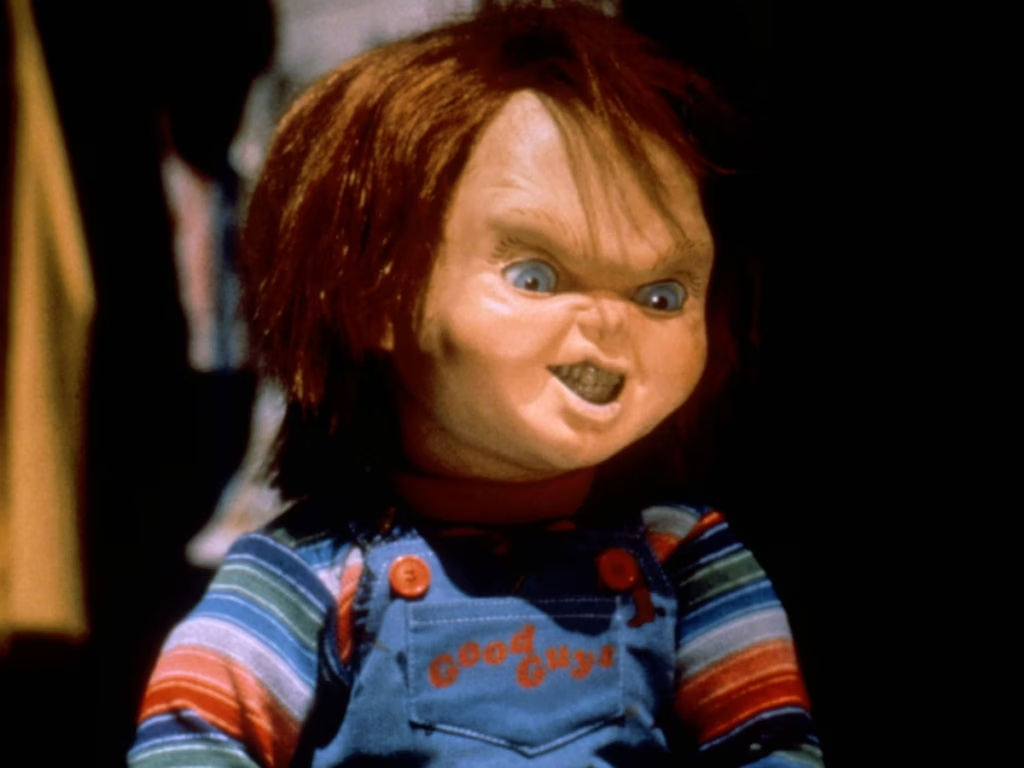
The original golem comes from Jewish folklore and the legends are said to still be believed by the strictest Jewish believers. In most of the tales, the Golem was a man made of clay created by a rabbi to protect the Jewish community from anti-semetic threats. In those tales the Golem went amok and had to be stopped by the same rabbi. Usually by changing the letters inscribed on the earthen figure. This version of the Golem was a common theme in the age of German expressionism films and appeared in 3 movies between 1915 and 1920. Of these three movies, only the 1920 Der Golem (aka: The Golem: How He came into the World) is still available, the other 2 being lost films. The idea of the clay golem still occasionally finds its way into horror; examples being 1967’s It!. The Golem (2018), and 2024’s Oddity to name but a few. The current definition of the golem would be any human-like figure created of non-living material and imbued with a life force that makes it animate. Looking at that definition we can include such creatures as animated dolls or dummies. This would include movies such as the Puppet Master and Child’s Play franchises. It would not include robots gone astray, so movies such as M3gen would not fall into this category. It could also include animated scarecrows as seen in a number of movies such as Hallowed Ground (2007) or Scary Stories to tell in the Dark (2019) Finally, if stretched, you could also include the flesh golem; or golems made of dead body parts animated with life. In such cases, movies such as all of the Frankenstein movies could be included. These creations are golems as opposed to the living dead, as the bodies are created from an amalgam of parts as opposed to a reanimated copse that you find in zombie or revenant movies. If you include the flesh golem into your definition, the golem may be one of the most commonly seen monsters in horror movies as Frankenstein alone has seen a multitude of versions including such features as Thomas Edison’s Frankenstein (1910); the monumental Universal version featuring Boris Karloff (31), Frankenstein 1970 (58), Mary Shelly’s Frankenstein (94) and the upcoming Guillermo del Toro film; not to mention the many odd interpretations or spin offs from the core movies such as Frankenstein meets the wolf man, Lady Frankenstein (71) or Army of Frankensteins (2013). According to google there are over 180 movies that feature Frankenstein’s monster.
The animating force of the golem differs from movie to movie whether it be magical (Der Golem), demonic, unknown, scientific (Frankenstein’s monster) or the living soul of another being (Chucky from Child’s play). Each has its own charm and fits well into the rampaging golem theme. Although honestly, sometimes leaving the animating spirt/source unexplained works the best to create an air of mystery; leaving us unsure of to the golem’s true intent and loyalties. The Golem then; has a long tradition both in legend and fiction as well as in cinema. It may be one of the oldest film monsters as well as one of the most popular.

Le Golem 1936

Golems in Horror

It! 1967
Child's Play 1988
Scary Stories To Tell in the Dark 2019
Frankenstein 1931

Werewolves

Uploaded 10/25/25

Unlike Frankenstein and Dracula, the werewolf in film does not have a fictional, book-based origin, but instead comes from folkloric belief, and even historical, legal, and theological documents.  The term Lycanthropy or the transfer from man to wolf comes from Greek mythology.  Taken from the name of King Lycaon who was turned into a wolf by Zeus after he the king killed, cooked and fed his own son to Zeus to test the God’s divinity.  He was not a true werewolf though, as he did not have the capability of returning to man-form.

Belief in werewolves date as far back as the days of the roman empire and perhaps longer, and are even hinted at in the bible in the book of Daniel when King Nebuchadnezzar grew long nails, becomes hairy and savage; living like an animal in the wilderness. Many cultures throughout history believed in a man that could become wolf or at least take on some of its aspects.  From the Viking berserkers to the native American Skinwalkers to the French loup-garou, all took on some aspect of the beast; if only its savagery.  The reasoning behind this ability was offered as witchcraft, a curse, or a natural ability, depending on the culture. 

Belief in werewolves really took hold in medieval times.  Much like witchcraft, suspicion and accusations of werewolves led to the hunting and persecution of people believed to carry the affliction; with many prosecuted and killed, primarily in the late 1400s through the 1500s.  Throughout many cultures the belief in werewolves was often linked with cannibalism as in 1589 the case of Peter Stumpp who was convicted and executed for being a werewolf, cannibal, and serial killer.  Werewolves were believed to have a uni-eyebrow, dark patches of skin, and an index finger longer than the middle finger, that would give them away in human form. 

Taken further, lycanthropy includes the transformation of humans into other creatures besides wolves depending on the culture and country.  For example: were-boars in Greece and Turkey; were-cats and were-crocodiles in Africa; were-fox in China & Japan; were-jaguar in South America as well as many others.

In film, the first movie featuring a werewolf is a lost silent film from 1913 simply entitled simply The Werewolf. At 18 minutes long, it focused on the daughter of a Navajo witch woman, who could transform into a timber wolf.  Appropriately enough, it was made by Universal Pictures. A second silent film was made in 1914 but is also lost.

The next foray into werewolves would be the 1935 film Werewolf of London, also by Universal; who hoped to follow up on the success of Frankenstein and Dracula.  This werewolf was more akin to Mr. Hyde as he looked like a bestial human and would put on his coat before going out to murder.  He also seemed to have a reasoning mind.  The movie didn’t do well at the box office and the next werewolf film to appear was the Wolf-man in 1941.  This Universal portrayal of Lycanthropy was far better received and reinvigorated the monster franchise for Universal as well as opening the door to more films based on wolfmen. 

Many of the tropes we see as werewolf lore today, silver needed to destroy werewolves and the passing of lycanthropy for a bite came from this 1941 film and not from actual historical legends.  It also cemented the one item carried over from its predecessor, the idea of the full moon causing the onset of the transformation to beast.  Most of these topes still remain in our social conscious today.  For example, ask anyone, even if they don’t follow horror, how to kill a werewolf and nearly all will say silver.  An idea from The Wolfman that did not take as strong a hold in the werewolf legend was the idea that the being cursed with lycanthropy would see a pentagram appear in the palm of his next victim; an idea meant to mirror the star of David forced to be worn by the Jews in Nazi Germany as the writer, Curt Siodimak, a Jew himself; had fled Germany just prior to the war upon hearing Nazi rhetoric growing more frequent.

Universal, bolstered by the success of The Wolf Man, revived the Frankenstein monster from 1931 to create the first know movie cross-over and first monster rally/monster mash-up as the two squared off in Frankenstein Meets the Wolf Man (1943).  Not a simple face to face fight, the movie was more of a continuation of Lawrence Talbot’s quest to remove the curse or die trying.  Its success encouraged Universal to return to their vault and bring back Dracula as well (this time played by John Carradine), to support their new monster.  Talbot’s story continued through House of Frankenstein until he was finally cured once and for all (inexplicably through brain surgery) in House of Dracula (1945).  This marked the end of the golden age of the universal monsters.  The monsters, with the unexplained return of Talbot’s Lycanthropy, showed up for a final send off in Abbott & Costello meet Frankenstein (1948).

The Werewolf as a monster was mostly dormant with only a few movies featuring him as more than a supporting monster through the 50’s as atomic monsters became the rage.  A few did sneak out though including Michael Landon in I was a Teenage Werewolf (1957).  After that, no other werewolf horror movie was released in the USA until 1971; the odd horror-biker movie cross-over Werewolves on Wheels.  However, Paul Naschy was pumping out his werewolf movies in Spain during this period; beginning in 68.   Werewolves began getting popular again in the 80s.  In 81, when special effects were finally catching up to the demands of werewolf movies, 2 true werewolf films were released; The Howling and An American Werewolf in London.  Both used practical special effects to great effect that year, and became werewolf classics. The Howling in particular set a new standard in Werewolf cinema.  Gone was the human with glued on hair but instead we saw full bodied, bi-pedal wolf-man Hybrids.  While American Werewolf in London’s creature was little more than a four-legged wolf-beast, the transformation scene was unlike anything seen before.  From there werewolf movies became popular again and have stayed in the mix up through today.  When CGI became all the rage some movies such as Wes Craven’s badly studio-interfered-with attempt Cursed (2004) tried to replace practical effects with computer effects.  They were poor and hurt the feature’s attempts at success.  To my eye, practical still carries the day over the CGI werewolves today, although they have gotten better since the early days. 

Overall, high quality werewolf films are difficult to come by.  By some estimates there are over 300 films on wolfmen and werewolves (there is no real difference between the two).  Yet only a small number of these are of any real quality.  One hindrance is the cost of the high caliber effects to both make a credible looking beast and do a believable transformation scene.  Failing these makes it hard to earn the viewers’ good will and any gain credibility.  Even when such criteria are met, many movies fail to make an impact because they use the werewolf as just another monster, with no depth of story or concept; hoping they can make the film work by inserting ample amounts of carnage and gore.

The Wolf Man 1941
Dog Soldiers 2002
Return of the Vampire 1943
Werewolf of London 1935
An American Werewolf in London 1981
The Howling 1981